

Dr. Samukeliso Dube, Executive Director, FP2030
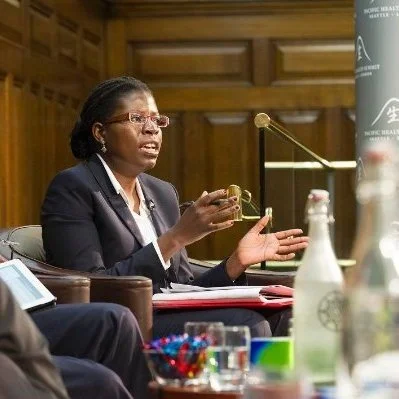
“In this current funding crisis, we could keep writing about the shrinking of overseas development assistance but it is not coming back. We would do better to ask ourselves - what else do we need to do?”
About Dr. Samukeliso Dube
Dr. Samukeliso Dube is the Executive Director of FP2030, a global partnership advancing voluntary family planning and reproductive health. With over 20 years of experience in health delivery, financing, and global health programming, she has held senior roles at Afrocentric Health, Philips (Africa), ArK, and PATH. Dr. Dube holds an MD from the University of Zimbabwe, an MPH, a Diploma in Tropical Medicine & Infectious Diseases, an MBA, and a Master’s in Finance & Investments.
Q: Describe a crisis, past or present, that tested your leadership in a significant way. What was the context, and what made it particularly challenging for you personally?
I lead a global organization focused on family planning, FP2030. The immediate crisis has been the radical change in the funding environment as we have been accelerating access to voluntary rights-based modern contraception across the world. This funding reduction is affecting not only my organization FP2030, but also the partners and countries that have relied on this funding, especially at the country level. Even though we have an ambition to accelerate progress on family planning globally, those whom we rely on implementing programs on the ground are also going through the crisis of reduction in funding.
As in other areas of global health, we have had to reconfigure our own architecture- including developing a new strategy that responds to newer ways of thinking that will meet the moment the world is facing. The crisis of funding and defunding of reproductive health programs demands rethinking what it means for our programs and the community at large. Ultimately, as a leader during a crisis, your organizational mission does not need excuses; rather, crisis requires courage of leadership that evolves a strategy that meets each moment.
We have seen this crisis unfold in a sector that was making so much progress. Today, we celebrate more than 101 million additional users of modern contraception since 2012 and have been gaining momentum. But for many months, we have been naming the problem. This is fair enough, because in leadership, you must name the problem before the problem starts naming you.
But great leadership starts naming a solution. So much is outside of my control as a leader. That transition from the monumental challenge to making sure that the problem isn’t the leader – the timing, the content, the ‘who’ is around the room - these are all key to emerging from the problem to designing a solution.
Needing to emerge very fast from the challenge is key. You have to draw on your inner resources and strengths, and to lead during ambiguity. In such a moment of confusion, the leadership is charged with making difficult decisions - do we wait and see, do we fundraise, do we reduce staff, what else do we do?
As a leader, the series of complex decisions requiring different parts of the brain - different strengths including the proverbial heart, hands and head – this is what has been asked of me as a leader. But, some decisions did not depend on me and my organization. Some decision-making involves host organizations where some of my team members were employed. I also report to a board that has helped shape many of my decisions. Most importantly, the leaders within FP2030 showed great leadership.
Q: Who were the key people (the stakeholders) depending on your leadership during that time, and what were their most pressing needs?
“[The leader’s] vulnerability signals that ‘there are things that I don’t know, there are things that I want to know, and I want you to walk with me through that journey’”.
My internal team has been great; they understood that many things are beyond our control. The environment for reproductive health is not favorable. But, out there, there are those who would put their social and political capital in support of family planning. During a crisis, it is so important to have a core team internally who the leader can lean on, who the leader can be vulnerable with and feel like we are going through this together. That vulnerability signals that “there are things that I don’t know, there are things that I want to know, and I want you to walk with me through that journey”.
The second set of stakeholders have been the Board of FP2030. This crisis has necessitated so many changes at the same time. My fear has been of change fatigue. We are changing the strategy to meet the moment, we are communicating with external partners whom we work with to meet the moment. We are managing internal staff anxieties to rise together with me to meet the moment. The new Board Chair and the Board have acknowledged the monumental nature of the crisis and it has been great to have them be supportive of how we are navigating.
Q: What did you hope to protect or achieve, for yourself and for those you were leading? How did you define success when the situation felt uncertain or unstable?
“We are more resourceful than we think, and we do not need to be tethered to the past.”
We have to acknowledge the monumental nature of the crisis. In a crisis, there is so much haziness. One definition of success is emerging from the hazy moments, waking up, showing up, and bringing people along.
Acknowledging that the crisis is transformative, and that we do not have to stay in the hazy moments forever, is another marker of success. What are the opportunities? Who else can come to the table in this new moment?
During this time, at FP2030, we embarked on a new strategy, even without the resources we previously relied on. My mandate is to accelerate progress by 2030. Even if resources are limited now, we do not stop. We are more resourceful than we think, and we do not need to be tethered to the past. Crisis needs leaders that say that we are going to lead differently, tap into strengths, and emerge stronger in an albeit different model.
We ask ourselves where else can resources come from, who else can bring resources to the table, how can we partner differently with governments who are indeed the custodians of the family planning agenda? In my heart of hearts, I believe any government, whether developed or emerging, needs to center their development agenda around reproductive autonomy. It’s the citizens of countries who benefit from family planning, and countries’ economies, educational attainments, health outcomes and even national security benefits from family planning. So, now the conversations are shifting. Governments come to the room, to the table, to lead the conversations centering this on their own sovereignty.
In this current funding crisis, we could keep writing about the shrinking of overseas development assistance, but it is not coming back. We would do better to ask ourselves - what else do we need to do? We need new money, new ways of funding, new funders, new ways of thinking. Can the contraceptive products be cheaper? Can they be made available differently? Can we include more private sector players? Can the players who have always been in the room make way for new players? Are there investors who could avail catalytic funding?
Q: How did you sustain yourself through the crisis period, practically and emotionally? Were there specific practices, disciplines, or sources of support that kept you grounded?
“Leadership is creating a future that doesn’t exist.”
The crisis can suck you into believing that you are the one who has to be independently resourceful to find the solutions on your own. You do that hoping that you’ll emerge faster from the crisis. But, this is a monumental crisis. Resources are available, in terms of ideas, ability, and capability. Knowing who to call - who your tribe or council is, having the wisdom to sift through noise to detect the signals. It is important for the leader to stay closely connected to the change that we want to see.
For us at FP2030, the change we work relentlessly towards is about accelerating the agenda for family planning. Who are the real beneficiaries for this agenda? It’s the governments and their people and it is important that we understand where their pulse is on that agenda. I am a firm believer that people who are experiencing a challenge or problem can help you co-create the future that you may not think of on your own. Leadership is creating a future that doesn’t exist. That future changes everyday and is dynamic. Leaders need to co-create the future with their constituency, their tribe, in an ongoing way, especially during a crisis.
Personally, it helps that I run. I live in Washington DC, which is a beautiful city. The dopamine from running in the morning gets me going. It has been life-changing to keep physically active.
If you have personal outlets of vulnerability, that also helps. It gives energy to go on when a loved one reminds you that you can solve the seemingly insolvable.
Q: What deliberate steps did you take to support the people you were leading? What do you think mattered most to them during that time?
“Who is the empathy checker in the senior team, the person who helps us to remember that people’s lives are at stake, and asks what we can do differently or how we can best support?”
Communication is key in a crisis. People want to be in the know. People want to help. A leader can never overcommunicate during such a crisis. Perhaps I was not doing it as well as I should but I took time to communicate with my team 2-3 times a week. I set up time for coffee chats with my team so that they can vent, explore. Having the team as key stakeholders is key.
For staff especially, being resourceful about what that next step could be is really important. Many organizations have coaching and other resources. As a leader, it is important to think about showing up with more than just writing a reference. Can we help people rewrite CVs, can we make a phone call on behalf of people, what practical guidance can we offer at times like this- when people are losing their jobs?
Exercising empathy is essential. If you know someone isn’t going to be part of the next chapter, how do you exercise empathy? As a leader, I may not realize that I’m acting outside empathy. Leading with empathy is the right thing to do. During a crisis, there are so many decisions to make as a leader every day.
Who is the empathy checker in the senior team, the person who helps us to remember that people’s lives are at stake, and asks what we can do differently or how we can best support? Designating a person whose role is to ensure that those decisions are grounded in empathy is very important. It has helped me to change the posture I assume, the timing of certain decisions, and the way that I communicate some decisions. Our empathy checker says, “before we communicate change this week, let’s do it this way”. If we have room to maneuver, the empathy checker helps us to shape and communicate decisions for maximal empathy. Every leader should have an empathy checker.
Do you draw on role models, mentors, or examples from history or your field as you navigated that crisis? What specifically did you take from them?
“In my leadership journey, I trust women, who know what family planning can do for their lives and the trajectory that unfolds before their eyes.”
The role models for many people who emerge from crisis are often those from war, or from a protracted crisis such as apartheid. In most of those crises, there is a clear enemy. In this crisis, I don’t view there being any one single enemy, except that the enemy could be the failure to name the problem and the failure to envision the future emerging right before your eyes.
My role models are business leaders who have created something from a crisis or emerging trend, who model the scenario of the future and create assets for that future.
I sit on the Board of Tiko, which was selected by The Audacious Project for using technology and new funding models to support millions of African adolescent girls with reproductive health and HIV testing, among other services.
In our normal way of doing business, we are often the ones bringing in supplies and figuring out how to deliver those services. Tiko instead is striving to determine how to get an ecosystem to deliver the services through the financing brain and the technology platform. The role model in this is transitioning the industry to young people.
I believe that there is still enough money in the world. We need intelligence and wisdom and to see that there’s enough to pay for family planning too.
In my leadership journey, I trust women, who know what family planning can do for their lives and the trajectory that unfolds before their eyes.
Q: Looking back, were there moments where your approach fell short of what the situation, or the people around you, needed? What would you do differently, and what has that taught you?
“We often say that it takes time to heal. But, it also takes people to heal.”
We never anticipated the USAID dismantling would remove family planning completely, especially for countries. We could have been smarter about scenario planning and prepared the field or countries that are navigating this magnitude of prolonged funding loss. By the way, we can still do more even today.
Now, what is being prioritized is what is perceived as urgent, not necessarily what is important. Outbreaks of ID, HIV treatment etc are perceived as urgent. But what we aren’t necessarily dealing with is what’s important in the development journey as a country is investment in people. We cannot invest in people without investing in family planning.
There have been multiple changes all at once, changing strategy, the operating model, how FP2030 is hosted. Our organization moved from centralized to decentralized and now to a country-differentiated model. There can be change fatigue associated with so much change.
In Nov 2025, I suffered a personal crisis when I lost my brother, who was murdered. It took time to start to write again, to communicate again. Realizing that, in such a time, you cannot be fully there is important to appreciate and respect. As a leader, you need to deal with human needs and vulnerabilities. Leaders need to be whole as they navigate and honor their own personal journey.
This loss happened when I was at the International Conference on Family Planning (ICFP). It didn’t take the pain away but it did make my heart full to have the support from the family planning community. My family coming together and my work community showing up have really helped. We often say that it takes time to heal. But, it also takes people to heal.
Q:Is there someone in your network whose resilience or leadership during this period deserves recognition? Someone you would want to acknowledge publicly?
“The seeds you sow everywhere as a leader, they do sprout. Sometimes they sit in the shadow of trees but plant the seeds anyway. They will emerge.”
Language conditions thought. Some people are afraid of naming family planning, reproductive health, or abortion. However, we do have supportive donors who have stayed and seem to be bold enough to continue to walk this journey with us. Those who are brave - the ones who remain standing, even though it may be hard - I want to salute those who remain standing.
Several people emerged strong from the crisis. Chris Purdy, CEO of DKT, is bold. CIFF has emerged as one of the bold organizations investing in sexual and reproductive health and rights and Miles Kemplay does daring things, like operating in ‘forgotten markets’. I work closely with Aparajita Ramakrishnan at the Gates Foundation, who has been supportive during our strategy refresh.
These are leaders that I can rely on. They don’t have scarcity thinking. They look forward with confidence.
Internally, Monica Kerrigan is our empathy checker. She dreams. She says we can’t bury our heads in the sand when we need to really show up. When the crisis erupted, we called a meeting on the Future of Family Planning. We advanced the message to be aspirational about family planning. In fact, we raised $5.5BN in pledges. That message said plenty. Working with Monica has been helpful to remind us that the cause hasn’t gone away just because the money seems to have diminished.
My daughter who turned 20 recently is a lovely person. She’s always spurring me on. “Mom, you’re a diva, you can do this, the girls need this”. I may not be a diva but seeing her emerge and become her own person and her own woman, carving her own space in the world, encourages me to lead with integrity, with gratitude, and with empathy.
The seeds you sow everywhere as a leader, they do sprout. Sometimes they sit in the shadow of trees but plant the seeds anyway. They will emerge.
Q:Many leaders find that a short phrase or principle anchors them during difficult times. Do you have a mantra or guiding aphorism you would be willing to share, and what does it mean to you in practice?
“Leadership is about creating the future that doesn’t exist.”
Leadership is about creating a future that doesn’t exist. This is a mantra that I live by. It brings in the possibility of what could be. It forces me to reflect. What could that future be?
My reflective moment is on Fridays. The future of FP should be different, if we accelerate it. More than 3 decades after ICPD, there are some countries where we’re recording prevalence rates for family planning of 2% or 5%. Can we as leaders recreate a future that doesn’t exist?
Grit, grace, and grounding: You have to work at it with grit. Allow yourself grace because you won’t solve it all in one go. Lean on others and remain grounded in your values and the cause.
Q:What would you want early-career colleagues in public health or medicine to carry with them as they build their own capacity for resilient leadership?
“Go learn something different from what your undergraduate degree was about.”
Resilience is about the ability to bounce back. What should bounce back? Is it the individual, the organization, or the cause?
For the individual to bounce back, don’t become too comfortable in one thing that you’re doing today. Create the future.
For the cause to bounce back, how do you get governments to own their health agenda, not just you leading and them following? You need to create a future that aligns with the trends that you see, that aligns with some of the sectors that are emerging.
I have background as a doctor and in finance - this kind of cross-sector thinking is the future. Early career professionals need to know that most careers aren’t going to be linear. I encourage them to embrace that, go learn something different from what your undergraduate degree was about. Pick up and go to a conference that's about something entirely different from what you know. Embrace what’s happening in other geographies and work to understand it, and to find new ways to solve problems.